
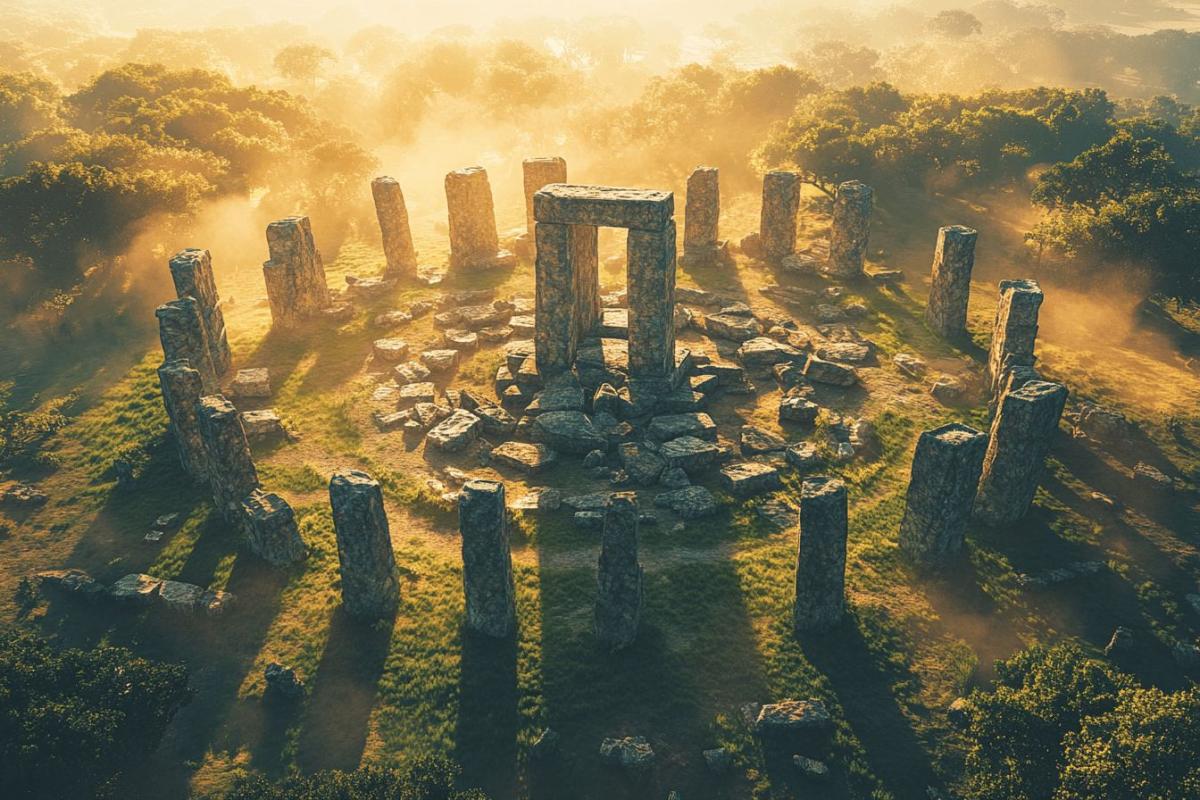
Nestled just a few kilometers from Seville lies one of Europe’s most remarkable prehistoric sites. Valencina de la Concepción thrived 5,000 years ago as a major power center and cultural hub during the Copper Age. This ancient metropolis flourished between 3200 and 2300 BCE, making it contemporary with other notable prehistoric monuments like Ancient burial site predating Stonehenge discovered : Groundbreaking archaeological find and Ireland’s Newgrange.
The rise of a prehistoric powerhouse
Discovered 150 years ago, Valencina has gradually revealed its secrets through decades of meticulous excavation and research. A recent study published in the Journal of Anthropological Archaeology by Leonardo García Sanjuán and Timothy Earle sheds new light on this extraordinary settlement. Spanning an impressive 450 hectares, Valencina stands as the largest prehistoric settlement ever discovered on the Iberian Peninsula.
The settlement emerged around 3200 BCE and reached its apex between 2900 and 2650 BCE. Archaeological evidence reveals a complex society with sophisticated trade networks and specialized production. Valencina’s strategic location where the Guadalquivir River once flowed into a large Atlantic bay positioned it as a crucial gateway controlling both inland river traffic and maritime routes between:
- The Mediterranean and Atlantic waters
- European and African territories
- Local and distant trading partners
- Coastal settlements and inland communities
This privileged position transformed Valencina into a major trading hub for valuable materials including ivory, amber, ostrich eggs, and copper. The site features monumental dolmens, elaborate ditches, artificial caves, wells, and thousands of ground pits that speak to its complexity and importance.
Archaeological findings suggest Valencina wasn’t a permanent settlement but rather served as a ceremonial gathering place. Evidence supporting this theory includes the scarcity of permanent dwellings, presence of non-local individuals in burial sites, and abundance of large ceramic plates in ritual contexts—some measuring up to 50 centimeters in diameter.
Unique governance and social structure
What makes Valencina particularly fascinating is its distinctive form of social organization. Unlike the hierarchical structures typically associated with early states, Valencina developed an alternative model of governance that balanced hierarchy and communalism. Rather than permanent government structures or large administrative buildings, archaeologists discovered ritual spaces, specialized production areas, and venues for periodic gatherings.
The power of Valencina’s elites rested on their ability to organize production and trade, controlling valuable resources such as:
| Resource | Significance |
|---|---|
| Salt | Essential for food preservation and trade |
| Copper | Revolutionary material for tools and weapons |
| Luxury items | Status symbols and ceremonial objects |
| Religious knowledge | Spiritual authority and ceremonial power |
Exquisite artifacts found in elite tombs demonstrate the remarkable craftsmanship of specialized artisans working under elite patronage. These include an ivory and rock crystal dagger, intricate shell beads, amber objects, and elaborate ceremonial garments. Perhaps most striking are gold foils featuring “oculi” motifs—distinctive eye-like symbols found near important burials like “The Ivory Lady.”
The researchers describe Valencina’s governance as a system founded on religious, political, and economic principles, operating through a delicate balance of hierarchy and communalism. This system controlled regional labor, staple food production, specialized wealth creation, and the circulation of special objects and materials—all likely supported by religious prestige centered around a famous sanctuary that attracted distant visitors.
Decline and legacy of a prehistoric metropolis
After reaching its zenith, Valencina experienced a crisis lasting approximately 50 years until 2600 BCE. Although the settlement recovered temporarily, it faced complete collapse after 2300 BCE. This decline coincided with the 4.2K climate event, which triggered severe droughts throughout the Mediterranean region. Once abandoned, Valencina never regained its former glory.
Valencina challenges traditional theories about societal evolution. It wasn’t a city-state resembling those in ancient Mesopotamia but rather demonstrates how cooperation, religion, and exchange networks can generate alternative, equally effective forms of power. The researchers suggest that Valencina’s monument-oriented production system may have actually prevented the rise of strongly stratified, state-type societies, acting as a kind of “social placebo” against authoritarian political systems.
The archaeological significance of Valencina extends beyond its impressive scale. It provides valuable insights into the complex interaction between economic intensification, central gathering places, demographic patterns, craft specialization, monumental construction, ritual practices, elite formation, and social inequality in pre-state, pre-urban societies.
Over time, the disappearance of central Neolithic and Chalcolithic mega-sites like Valencina and Antequera cleared the path for new socio-political structures to emerge. This transition represents a fascinating chapter in human history—one that continues to offer valuable lessons about alternative pathways to social complexity and power.
The remarkable archaeological discoveries at Valencina provide a window into a sophisticated prehistoric society that thrived 5,000 years ago. Its legacy reminds us that human civilization has followed diverse paths, with some societies developing complex social organizations without adopting the rigid hierarchies typically associated with early state formation.

- Once-extinct European wildcats set to make a comeback in England - September 21, 2026
- Joe Salisbury takes break from tennis due to anxiety struggles - September 20, 2026
- Andy Haldane slams Budget 2025 for repeated policy mistakes - September 19, 2026

