
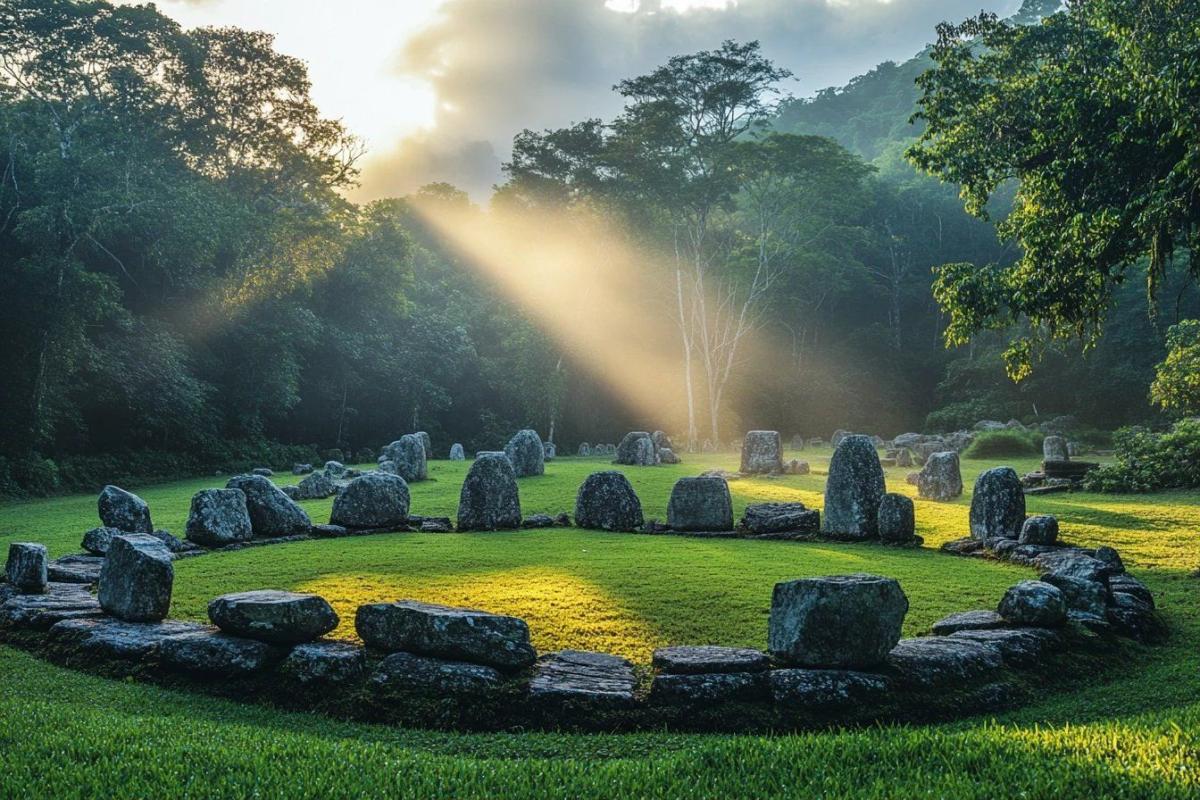
Nestled in the heart of Salem, New Hampshire, a mysterious complex of stone structures has captivated researchers and visitors alike for decades. America’s Stonehenge stands as one of the most enigmatic archaeological sites in North America, raising profound questions about who first settled the continent. The 30-acre site atop Mystery Hill features numerous stone formations that have sparked intense debate among historians, archaeologists, and enthusiasts about their true origins.
The mysterious discovery that rewrote American history
In the 1950s, property owner Bob Stone made a remarkable discovery that would challenge conventional historical narratives. While examining his land, Stone noticed unusual carvings and markings on slab stones used to support structures on his property. This finding would eventually suggest human presence in North America thousands of years before Christopher Columbus’s arrival.
Harvard scholar Barry Fell was among the first academics to investigate the site. After careful examination, Fell proposed that the markings represented a dedication to a Phoenician god, written in Iberic and Ogam script. He theorized that the stone chambers served as religious shrines constructed by Celtic peoples. Days after Stone’s initial discovery, similar inscribed slabs were found in central Vermont, suggesting a wider presence of these mysterious settlers.
This discovery fundamentally challenged the established timeline of North American settlement. Prior to these findings, most Americans believed their history began with Columbus. The evidence at America’s Stonehenge indicated that Norsemen and Irish monks potentially inhabited the northern regions of the country as early as 800 A.D., predating Columbus by nearly seven centuries.
Further linguistic analysis revealed that some river names in the region derived not from Native American dialects but from Celtic languages. For example, while “Merrimack” means “deep fishing” in Algonquian, “Morriomach” in Gaelic translates to “of great depth”—an intriguing parallel that hints at possible Celtic influence in pre-Columbian New England.
| Proposed Creators | Time Period | Supporting Evidence |
|---|---|---|
| Indigenous Peoples | 1st-16th centuries | Artifacts with direct ties to native stone workers |
| Irish Monks | Around 880 A.D. | Similarities to Irish megalithic structures |
| Norsemen | 800-1000 A.D. | Runic inscriptions and construction techniques |
| Phoenicians/Celts | Pre-1000 A.D. | Iberic and Ogam script inscriptions |
Archaeological excavations and intriguing findings
The first formal excavation of America’s Stonehenge began in 1961, though unfortunately, no comprehensive report was ever filed. From what researchers gathered, the excavation unearthed numerous quartz crystals from an approximately 18-foot deep well on the property. These crystals were naturally formed, suggesting that whoever constructed and used the well might not have placed them there intentionally.
Several theories emerged about the well’s purpose, ranging from mundane to extraordinary:
- An underground burial tomb for ancient settlers
- A primitive mine shaft for resource extraction
- A sacrificial well for religious ceremonies
- An ancient wishing well with spiritual significance
- A simple water source for the site’s inhabitants
Further excavations revealed even more intriguing features. Researchers discovered triangular caves with markings made by ancient tools, filled with rounded stones that appeared to have ritual significance. They also found what was believed to be a “mensal stone,” theoretically used to support women during menstruation—suggesting complex social and possibly religious practices among the site’s creators.
One of the most controversial discoveries was a stone slab with carved channels and drainage outlets. The slab’s dimensions roughly matched those of an outstretched human body, leading some researchers to speculate it was used for human sacrifice or ritualistic bloodletting ceremonies. More conservative interpretations suggest it may have served as a platform for wine production or other practical purposes.
Unfortunately, much of the site’s archaeological integrity has been compromised over centuries. Earthquakes in the mid-1700s, stone quarrying operations in the mid-1800s, and problematic excavations and reconstructions have destroyed crucial evidence that might have definitively answered questions about the site’s origins.
The complex ownership saga of Mystery Hill
The documented history of the property begins in 1835 when Jonathan Pattee selected the land for his homestead. Practical-minded, Pattee repurposed several of the existing caves as cellars and utilized some of the stone slabs to construct a barn. This early recorded use shows how the site has been continuously adapted by successive inhabitants.
The earliest published reference to the structures appeared in Edgar Gilbert’s 1907 “History of Salem, New Hampshire,” which attributed the site to Native American occupation. However, Gilbert noted the paradox that the local tribes were not known to have built such extensive stone structures.
In the 1930s, William Goodwin of Hartford, Connecticut, purchased the property and became obsessed with uncovering its origins. Unfortunately, his enthusiasm exceeded his archaeological expertise. Goodwin fenced off the area and conducted unscientific excavations that irreparably damaged the site’s archaeological integrity and undermined future researchers’ ability to properly survey the land.
Goodwin’s travels had exposed him to megalithic remains throughout Europe, the Mediterranean, and the British Isles. He noted striking similarities between these structures and those at Mystery Hill, hypothesizing they shared a common origin. His research led him to believe that Irish monks who potentially arrived in America around 880 A.D. had constructed the site, though this theory remains controversial among academics.
Over the decades, alternative theories about the site’s usage emerged. Some local traditions suggest the caves served as hiding places on the Underground Railroad, providing refuge for escaped slaves traveling to Canada. Other stories claim that robbers and criminals used the caves as hideouts between the 1870s and 1930s, highlighting the site’s continued utility throughout American history.
In 2019, the site suffered further vandalism from individuals using power tools, highlighting the ongoing challenges of preserving this archaeological treasure. Today, the property operates as a tourist attraction known as America’s Stonehenge, allowing visitors to form their own conclusions about this enduring mystery of American prehistory.
The lasting archaeological enigma
Despite decades of research, America’s Stonehenge remains one of North America’s most perplexing archaeological sites. The evidence points to multiple possible creators: indigenous peoples, transatlantic visitors like Irish monks or Norsemen, or some combination of successive occupants over centuries.
What makes this site particularly valuable is how it challenges conventional narratives about pre-Columbian contact. The potential evidence of European visitors nearly seven centuries before Columbus forces historians to reconsider established timelines of American settlement and cultural exchange.
As archaeological methods continue to advance, perhaps future generations of researchers will unlock the secrets of America’s Stonehenge. Until then, it stands as a testament to human ingenuity across cultures and a reminder that history is often more complex and interconnected than we initially assume.

- Once-extinct European wildcats set to make a comeback in England - September 21, 2026
- Joe Salisbury takes break from tennis due to anxiety struggles - September 20, 2026
- Andy Haldane slams Budget 2025 for repeated policy mistakes - September 19, 2026

