
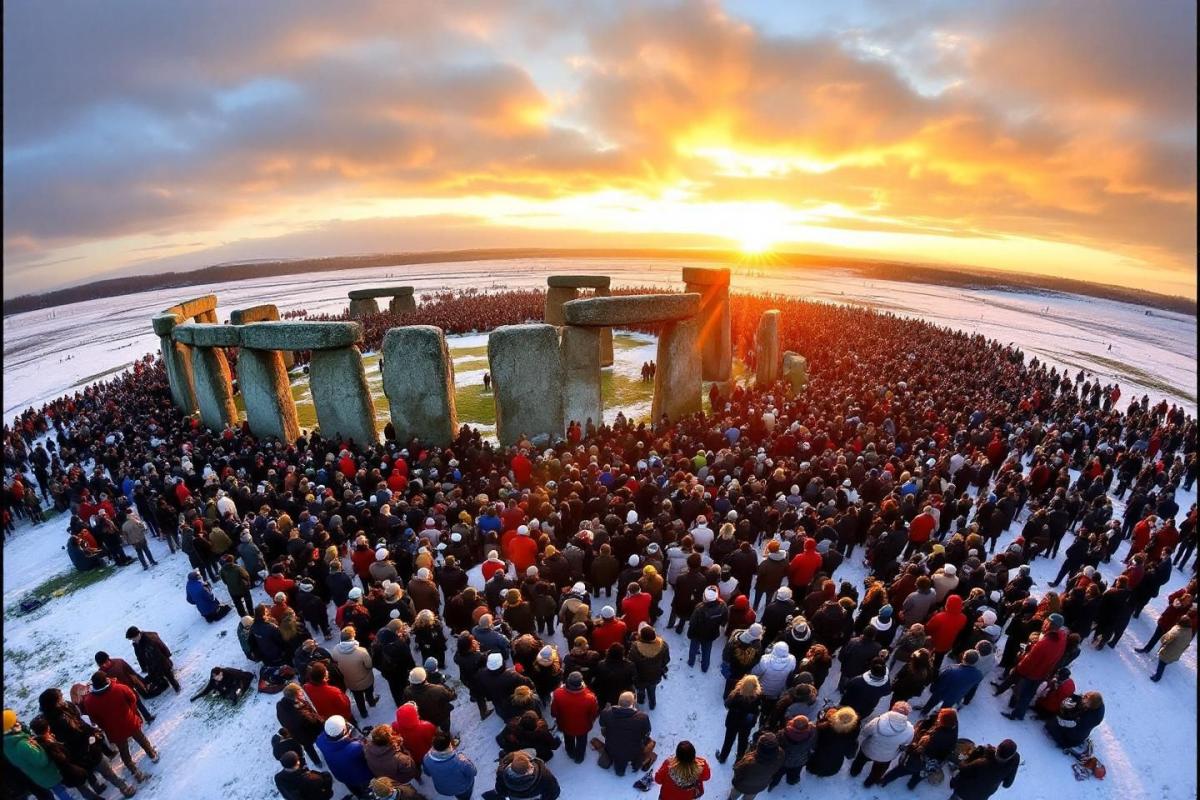
Ancient traditions came alive on December 21st as the prehistoric monument welcomed its annual gathering of spiritual seekers, revellers and curious visitors. The experience offered a rare opportunity for people to approach the sacred stones closely, creating moments of profound connection with this 5,000-year-old site. Despite cloudy conditions obscuring a perfect view, the atmosphere remained electric with drumming, dancing and celebration marking humanity’s oldest seasonal observance.
A gathering rooted in prehistoric significance
The event drew approximately 8,500 attendees who gathered as gates opened at 05 :15 GMT. This represents a significantly smaller crowd compared to the summer equivalent, which typically attracts around 25,000 participants. The manageable numbers allowed visitors better access to the stone circle, though reaching the centre still required early arrival and determination.
Win Scutt from English Heritage, the organization managing the site, explained the historical importance of this particular celestial moment. Archaeological excavations have revealed evidence of midwinter feasting in prehistoric times, including remains of eight-month-old pigs specifically slaughtered for these celebrations. This timing proves the cultural significance, as sows farrow in spring, making the animals precisely eight months old during the winter solstice period.
The monument itself dates back to around 3,000 BC, when a circular ditch created an enclosure approximately 100 metres in diameter. The iconic stones were positioned around 2,500 BC, though evidence suggests the surrounding area may have held large totem poles between 8,500 and 7,000 BC. While the stones align with both midwinter and midsummer sunrises, the winter event has always held greater cultural resonance throughout history.
| Stonehenge timeline | Approximate date | Development |
|---|---|---|
| Earliest activity | 8,500-7,000 BC | Possible totem pole placement |
| Early monument | 3,000 BC | Circular ditch construction |
| Stone placement | 2,500 BC | Iconic stones positioned |
Personal journeys to witness the shortest day
Visitors travelled from extraordinary distances to participate in this symbolic moment. Bradley O’Neill journeyed from Australia specifically to witness the event as part of his European bucket list tour. Speaking with visible emotion, he described the experience as fulfilling a long-held dream. The opportunity to touch the stones and feel their presence moved him deeply, creating a spiritual connection he had sought for years.
Sophie McCarthy travelled from Edinburgh, equipped with elaborate costume and drums to join the pagan celebration at the heart of the stone circle. Surrounded by newfound friends creating spontaneous rhythms together, she described the experience as magical. For her, the occasion represented the sun being born anew, symbolizing life returning after the darkest period.
Rob, 38, and Adam, 43, embarked on an even more ambitious adventure. The pair walked from their Somerset homes to the monument on December 20th, choosing to beat the crowds by celebrating one day early. Following their sunrise observation, they completed a remarkable 61-kilometre run home, taking six hours and forty minutes. While both had running experience, this represented by far their longest distance, creating what they described as a special if extremely challenging way to honour the solstice.
Cultural expressions and spiritual traditions
The celebration incorporated diverse cultural practices from around the world. Golnar Pooya, a Persian Zoroastrian visiting from the United States, explained her tradition’s 2,500-year history of marking this night. Her faith observes the occasion by staying awake through darkness, consuming pomegranates symbolizing birth and rebirth, gathering with family, and reading poetry until sunrise. She found witnessing people from multiple cultures converging at the prehistoric site particularly spectacular.
Morris dancers performed traditional folk dances symbolizing the Earth’s rebirth and the promise of lengthening days. These ritualistic movements connect participants with ancient traditions celebrating fertility and nature’s cycles. The Ridley-Thompson family from Nottingham demonstrated typical dedication, waking at 02 :00 GMT and driving three hours for their third consecutive annual visit.
BBC reporter Sophie Parker observed significant emotion throughout the morning gathering. The spiritual atmosphere proved powerful despite mild December weather and cloudy skies preventing a clear sunrise moment at 08 :09 GMT. The absence of unified cheering likely resulted from obscured views, though this didn’t diminish the joy evident throughout the crowd.
Recent controversies have touched the monument, including incidents involving activists. Stonehenge protesters plead not guilty to Just Stop Oil paint charges, demonstrating ongoing tensions between conservation and activism at this significant heritage site.
The universal celebration of light returning
Similar observances occur worldwide, demonstrating humanity’s shared reverence for this astronomical turning point. In Iran and Central Asia, families celebrate Yalda by gathering through the longest night, consuming red fruits like watermelon and pomegranate while reciting poetry. At Newgrange in Ireland, a structure older than Stonehenge dating to 3,200 BC, dawn sunlight illuminates an inner chamber through precisely positioned gaps. China marks Dongzhi with families sharing meals featuring traditional rice balls called Tang yuan. Antarctica’s research station scientists commemorate the occasion by taking freezing polar plunges through holes cut in ice.
These parallel traditions highlight humanity’s enduring need to mark seasonal transitions. English Heritage emphasizes careful treatment of the stones during these special access periods, as rare lichens and incredible carvings require protection. The balance between allowing meaningful spiritual access and preserving this irreplaceable archaeological treasure remains paramount.
As the morning concluded, participants dispersed carrying renewed optimism. The symbolic emergence from darkness into lengthening days resonates across millennia, connecting contemporary celebrants with countless generations who gathered at this same location. This continuity demonstrates the enduring power of natural cycles to unite humanity across cultures, beliefs and centuries.

- Husband and 5 other men charged with sex offences against ex-wife - November 25, 2026
- Husband and 5 other men charged with sex offences against ex-wife - November 25, 2026
- Thousands welcome winter solstice as sun rises over Stonehenge - November 24, 2026

