
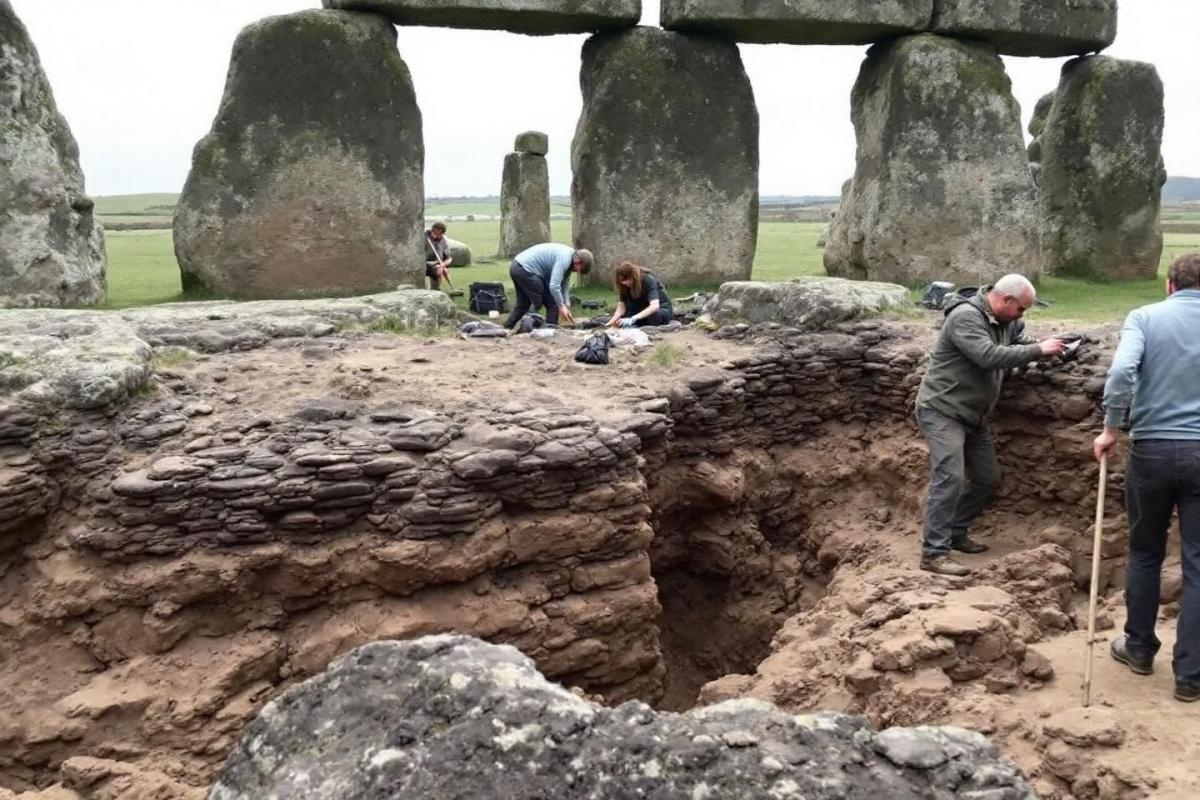
A revolutionary archaeological breakthrough is reshaping our understanding of prehistoric Britain’s landscape. Scientists have conclusively demonstrated that enormous circular pits near Stonehenge were indeed crafted by human hands thousands of years ago, settling a debate that has captivated experts since their initial discovery. This groundbreaking confirmation emerged through an innovative blend of cutting-edge scientific methodologies never before combined in archaeological research.
Innovative scientific techniques reveal ancient human engineering
The research team employed multiple geophysical technologies to investigate the massive Durrington structure without conducting prohibitively expensive full-scale excavations. Professor Vincent Gaffney from Bradford University’s School of Archaeological and Forensic Sciences spearheaded this pioneering approach, combining electrical resistance tomography with radar and magnetometry to map the pits’ dimensions accurately. These sophisticated instruments revealed features spanning over a mile in diameter, with individual cavities reaching depths of 5 metres and widths up to 10 metres.
The scale of these features demanded creative investigative solutions. Traditional excavation methods would have required substantial financial resources and years of fieldwork. Instead, the team extracted sediment cores from various locations across the site, subjecting them to advanced analytical procedures. Optically stimulated luminescence dating measured when soil particles last encountered sunlight, while sedDNA analysis recovered ancient genetic material from plants and animals preserved within the earth.
These complementary techniques produced repeating patterns across different sampling locations, patterns that could only result from deliberate human activity rather than natural geological processes. According to Gaffney, such consistent signatures throughout the massive site eliminate any possibility of natural formation. The combination of geophysical mapping and biochemical analysis provided irrefutable evidence that prehistoric communities deliberately excavated these features.
The Durrington circle’s extraordinary scale and construction
This prehistoric marvel encompasses approximately 20 individual pits arranged in a sweeping arc around the Neolithic settlements of Durrington Walls and Woodhenge. First announced in 2020, the structure was immediately hailed as potentially Britain’s largest prehistoric monument, surpassing even the iconic stone circle itself in sheer territorial scope. The discovery suggested sophisticated organizational capabilities among ancient communities.
Carving these cavities from Wiltshire’s chalky bedrock would have demanded extraordinary determination, advanced planning, and considerable engineering expertise. The creators faced significant technical challenges in maintaining consistent spacing across such vast distances. This led researchers to propose that the monument’s construction might represent early evidence of numerical counting systems, as tracking positions across such expansive terrain would have required systematic methods beyond simple visual assessment.
| Feature | Measurement | Significance |
|---|---|---|
| Circle diameter | Over 1 mile | Largest prehistoric structure in Britain |
| Individual pit width | Up to 10 metres | Massive excavation effort required |
| Pit depth | Up to 5 metres | Significant engineering knowledge needed |
| Estimated number | Approximately 20 pits | Coordinated community project |
The relationship between this pit circle and nearby monuments adds another layer of intrigue. Unlike Stonehenge, which appears oriented toward celestial observations, the Durrington structure suggests different cosmological concerns. Researchers theorize these excavations might have symbolized connections to an underworld, representing beliefs fundamentally different from the astronomical alignments associated with the stone monument. Similar patterns of ancient construction can be found in the circular burial site predating Stonehenge, revealing how prehistoric communities continuously adapted their ceremonial landscapes.
Resolving skepticism through rigorous scientific validation
Initial announcements of the pit circle’s discovery met with considerable professional skepticism. Critics questioned whether these features represented genuine archaeological monuments or merely natural geological formations created by erosion or other environmental processes over millennia. Such doubts underscored the need for comprehensive scientific validation before accepting claims about Britain’s largest prehistoric structure.
The research published in Internet Archaeology, titled “The Perils of Pits,” directly addresses these concerns through methodical investigation. Key factors supporting human origin include :
- Consistent sediment patterns across widely separated sampling locations
- Evidence of deliberate excavation visible in soil stratification
- Uniform depths and dimensions suggesting planned construction
- Archaeological materials recovered from sediment cores
- Geometric precision in pit placement across vast distances
These findings collectively eliminate natural explanations. Gaffney emphasizes that random geological processes simply cannot produce the observed patterns with such consistency across such extensive areas. The team’s confidence stems from multiple independent lines of evidence all pointing toward the same conclusion : deliberate human construction during the late Neolithic period, more than 4,000 years ago.
Understanding prehistoric cosmology inscribed on the landscape
The confirmation of human construction opens fascinating questions about ancient belief systems and ceremonial practices. While definitive answers about the circle’s purpose may forever remain elusive, Gaffney suggests the monument represents something unprecedented in British archaeology : a massive cosmological statement inscribed directly onto the landscape itself. The structure’s scale and positioning indicate beliefs about underworld realms might have dominated religious thinking in this region.
This interpretation gains credibility from the monument’s relationship with surrounding sites. Positioned to encompass existing settlements at Durrington Walls and Woodhenge, the pit circle created a defined sacred territory marking boundaries between earthly and supernatural realms. Such spatial organization reflects sophisticated theological concepts about cosmic order and humanity’s place within it, expressed through monumental landscape modification rather than constructed architecture.
The implications extend beyond individual monuments to illuminate broader patterns in Neolithic society. If Stonehenge represented celestial connections and the Durrington circle symbolized chthonic realms, the Salisbury Plain hosted competing or complementary religious traditions coexisting within a relatively compact area. Understanding these relationships helps reconstruct the complex spiritual landscape of prehistoric Britain, revealing communities far more philosophically sophisticated than previously imagined.

- Archaeologists confirm humans carved massive pits near Stonehenge with new evidence - October 8, 2026
- Salisbury companies gave back to the community with 500 chicken dinners - October 7, 2026
- Tourist tax to be introduced across England for overnight visitors - October 6, 2026

