
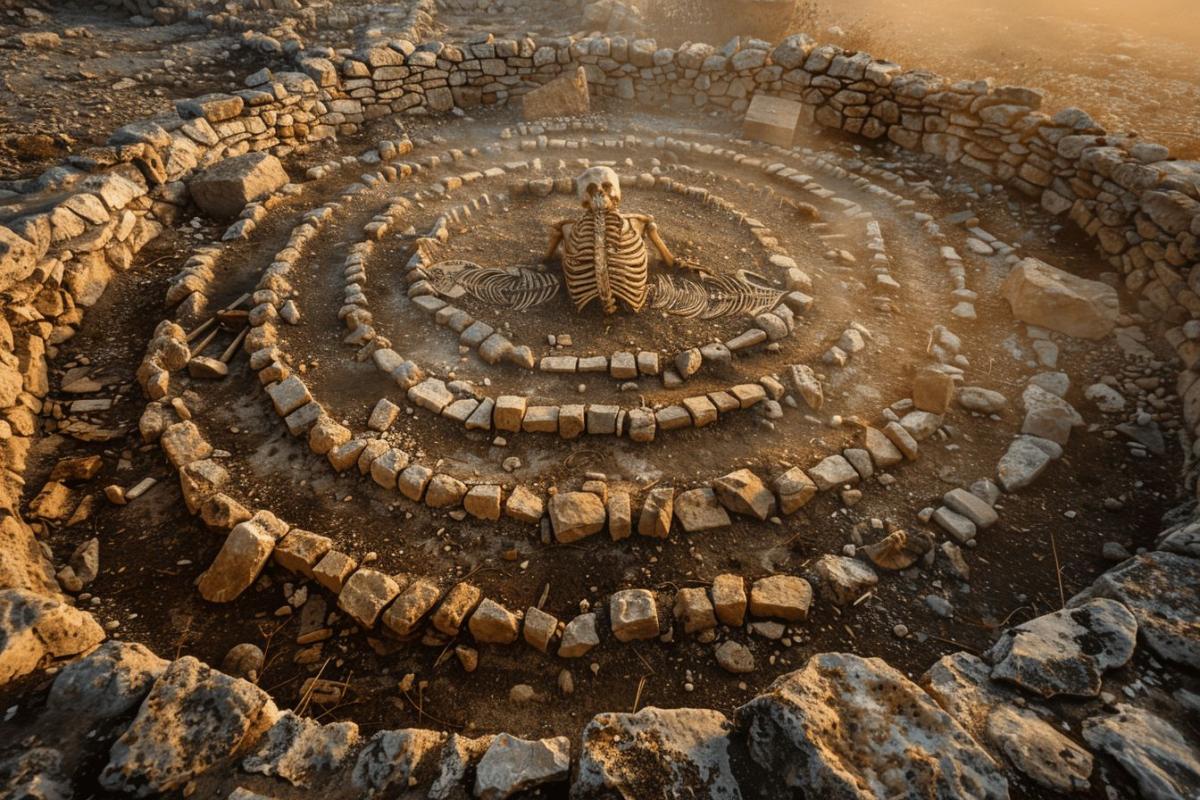
Archaeologists have made a groundbreaking discovery that reshapes our understanding of prehistoric Britain. The circular burial enclosure at Flagstones near Dorchester has been conclusively dated to around 3200 BCE, making it approximately two centuries older than previously thought. This remarkable finding positions the site as potentially Britain’s oldest circular ceremonial monument, predating the iconic first phase of Stonehenge by about 300 years. The revelation comes from advanced radiocarbon dating techniques that have illuminated new timelines for Neolithic cultural developments.
Revolutionary discovery changes prehistoric timeline
Nestled in the rolling hills of southwest Britain lies an archaeological treasure that remained hidden for millennia. The Flagstones circular enclosure was only uncovered during construction work in the 1980s, partially beneath Thomas Hardy’s former residence and extending under the modern Dorchester bypass. What makes this site extraordinary isn’t just its age but its near-perfect circular design, measuring approximately 100 meters in diameter.
Recent scientific dating efforts led by Dr. Susan Greaney from the University of Exeter and Dr. Peter Marshall have transformed our understanding of the site’s chronology. Their team obtained 23 new radiocarbon measurements from human remains, red deer antlers, and charcoal samples, working with leading laboratories at ETH Zürich and the University of Groningen.
The results revealed a fascinating timeline:
- Initial activity at the site dates back to around 3650 BCE
- After a significant gap, the circular enclosure was constructed around 3200 BCE
- Burials were placed within the monument shortly after construction
- A young adult male was interred beneath a massive sarsen stone about 1,000 years later
“The chronology of Flagstones is crucial for understanding the sequence of ceremonial monuments in Britain,” explains Dr. Greaney. “Its design bears striking similarities to Stonehenge’s first phase, which dates to approximately 2900 BCE. This raises intriguing questions about whether Stonehenge was influenced by earlier stone circles like Flagstones.”
Middle Neolithic transformation and circular monuments
The Middle Neolithic period (approximately 3400-2800 BCE) marked a profound shift in monumental architecture across Britain and Ireland. Builders began abandoning the traditional long, rectangular structures like barrows and cursus monuments that had dominated earlier landscapes. In their place arose large circular enclosures called proto-henges or formative henges.
These new circular monuments shared distinctive characteristics:
| Feature | Description |
|---|---|
| Size | Typically 80-110 meters in diameter |
| Structure | Defined by ditches, banks, and narrow entrances |
| Purpose | Primarily ceremonial with burial elements |
| Interior | Often featured pits for cremations and inhumations |
The transition from linear to circular design wasn’t merely aesthetic—it reflected deeper cultural transformations. These new monuments emphasized order, symmetry, and possibly more centralized ceremonial practices. The careful placement of human remains within these spaces suggests evolving concepts of death, ancestral connections, and sacred geometry.
Flagstones itself was carved into chalk bedrock with remarkable precision. Some pits contained burials, including a cremated adult beneath a sarsen stone and three uncremated children, one covered with a limestone slab. Additional cremations were discovered in a ring-shaped ditch, confirming the site’s importance as a burial ground.
Network of sacred sites across ancient Britain
Flagstones wasn’t an isolated phenomenon. It appears to have been part of an interconnected network of ceremonial spaces spanning prehistoric Britain. The site shares key characteristics with other monuments like Llandygái ‘Henge’ A in Gwynedd, Wales, where excavations also revealed cremated remains within a segmented enclosure.
The similarities in monument design, burial practices, and ritual activities indicate extensive cultural exchange across Neolithic communities. Artifacts and burial customs at Flagstones suggest connections extending to Ireland, revealing a sophisticated network of shared ideas and beliefs crossing the Irish Sea.
The Dorchester area itself boasts several major prehistoric monuments whose chronology is now better understood:
- Maiden Castle’s causewayed enclosure (3660-3525 BCE)
- Flagstones circular enclosure (circa 3200 BCE)
- Mount Pleasant henge (2615-2495 BCE)
Flagstones bridges the chronological gap between earlier linear enclosures and later monumental henges, helping archaeologists track the evolution of ceremonial architecture. This enhanced timeline demonstrates that Flagstones wasn’t merely a local experiment but part of a broader wave of innovation sweeping across Neolithic Britain.
Legacy of an ancient sacred space
Despite lying partially beneath modern infrastructure, Flagstones’ archaeological significance continues to grow. As a scheduled monument with excavation archives preserved at the Dorset Museum, it provides crucial insights into prehistoric cultural development.
Perhaps most intriguing is the discovery that people returned to Flagstones approximately 1,000 years after its construction to bury a young man beneath a massive sarsen stone. This long-term memory of the site’s importance suggests these ancient monuments maintained their sacred status across many generations.
The refined dating of Flagstones reshapes our understanding of how monumental ideas spread throughout prehistoric Britain. Rather than seeing Stonehenge as the originator of circular ceremonial architecture, we now recognize it as part of a longer tradition potentially inspired by earlier sites like Flagstones.
As archaeologists continue applying advanced dating techniques to prehistoric sites, our picture of Neolithic Britain grows increasingly nuanced. These ancient circular monuments weren’t just impressive engineering feats—they were powerful expressions of changing spiritual beliefs, social organization, and cultural connections that spanned centuries and crossed geographical boundaries.

- Three children charged with murder in court following man’s death - March 22, 2026
- Three children charged with murder in court following man’s death - March 22, 2026
- Fire breaks out in field near Stonehenge world heritage site - March 21, 2026

