
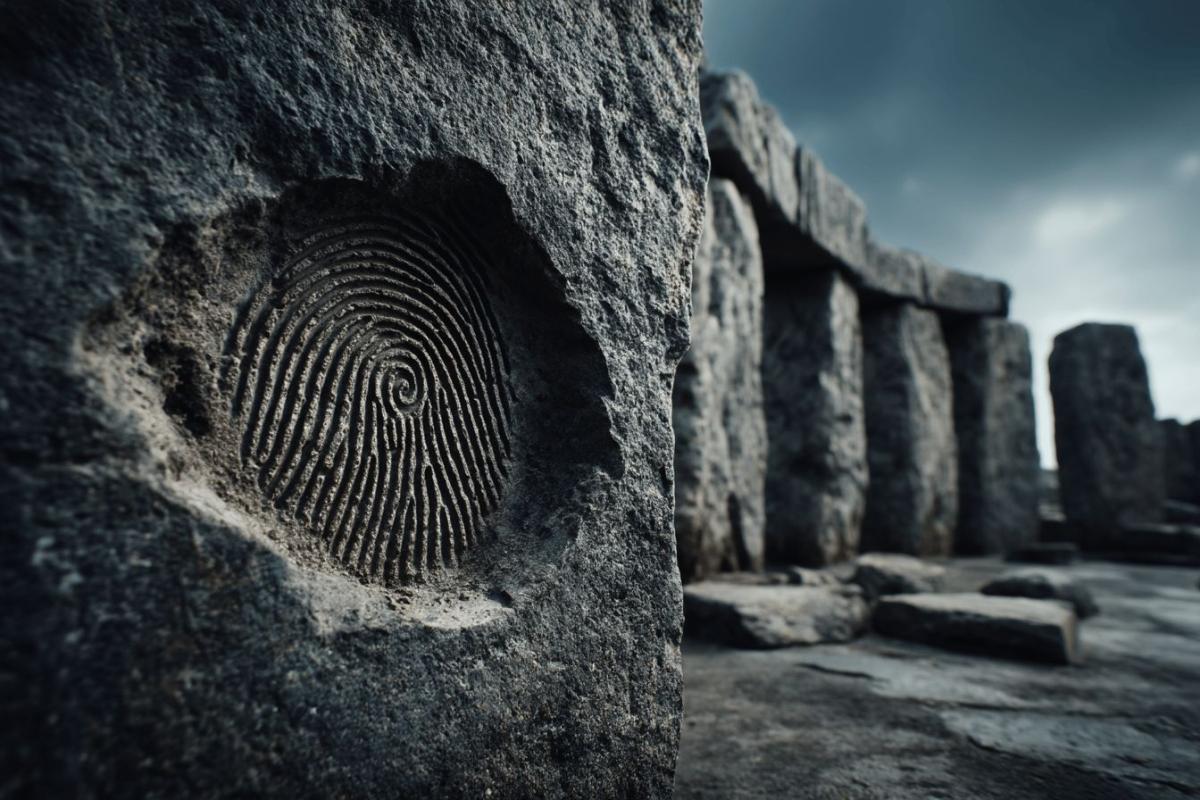
A recent scientific breakthrough has sent ripples through the archaeological community. Researchers have identified a human fingerprint on a Stonehenge slab, providing unprecedented direct evidence of human contact with this ancient monument. This remarkable discovery at the iconic prehistoric site in Wiltshire, England, offers fresh insights into how these massive stones were handled and positioned by our ancestors.
The groundbreaking fingerprint discovery at Stonehenge
Scientists from Curtin University have recently confirmed the presence of an authentic human fingerprint preserved on one of Stonehenge’s central slabs. This fingerprint, estimated to be over 4,500 years old, was discovered during a routine examination of the Altar Stone, a six-ton block of sandstone measuring approximately 16 feet by 3 feet that lies at the heart of the monument.
The fingerprint was preserved in what appears to be a thin layer of mineral deposits that formed on the stone’s surface shortly after it was positioned. Advanced imaging techniques allowed researchers to capture high-resolution images of the print, revealing distinctive whorl patterns that match human fingerprint morphology.
“This is the first direct physical evidence of human hands touching these specific stones,” explains Dr. Anthony Clarke, lead researcher. “While we’ve always known humans built Stonehenge, finding an actual fingerprint creates an immediate personal connection across millennia that’s genuinely moving.”
The discovery offers compelling new evidence about the construction methods used at Stonehenge. The location and orientation of the print suggests that at least some of the positioning work was done by hand, rather than exclusively using ropes or wooden frameworks as previously theorized.
New findings about the Altar Stone’s origins
Beyond the fingerprint discovery, recent research has dramatically revised our understanding of the Altar Stone’s origins. Previous theories suggested this distinctive sandstone slab originated in Wales, similar to Stonehenge’s bluestones. However, chemical analysis has now linked the Altar Stone to northeastern Scotland, approximately 750 kilometers (466 miles) from Stonehenge.
The research team created a chemical fingerprint of the stone by analyzing mineral grains within fragments. Their findings revealed a surprising age profile:
- Most mineral grains date between 1,000 to 2,000 million years old
- Other minerals are approximately 450 million years old
- This distinctive pattern matches rocks from the Orcadian Basin in Scotland
- The chemical composition differs significantly from Welsh bedrock
Professor Richard Bevins of Aberystwyth University, who co-authored the study, notes that this discovery “opens a new chapter in our understanding of Stonehenge’s construction.” The team is now working to pinpoint the exact quarry site in Scotland where the Altar Stone originated.
The distance between northeastern Scotland and Wiltshire raises profound questions about transportation methods used by Neolithic societies. Such a journey would have required extraordinary coordination and sophisticated logistics.
Reimagining Stonehenge’s construction
The combined discoveries of the human fingerprint and the Altar Stone’s Scottish origins have forced archaeologists to reconsider established theories about Stonehenge’s construction. Professor Chris Kirkland of Curtin University explains that these findings point to “a significantly higher level of societal organization during the Neolithic period than previously understood.”
The massive distance between the stone’s origin and its final placement suggests sophisticated transportation methods. Overland transport of a six-ton stone across such terrain would have been exceptionally challenging. Researchers now believe a marine shipping route along Britain’s coast represents the most plausible explanation.
| Stone Type | Origin | Approximate Distance to Stonehenge | Estimated Weight |
|---|---|---|---|
| Sarsen Stones | Marlborough Downs (Wiltshire) | 25-30 km | 20-30 tons each |
| Bluestones | Preseli Hills (Wales) | 240 km | 2-5 tons each |
| Altar Stone | Orcadian Basin (Scotland) | 750 km | 6 tons |
This evidence points to extensive trade networks spanning ancient Britain, challenging the notion that Neolithic communities operated primarily in isolation. The logistics required for such transportation would have demanded cooperation between multiple communities across vast distances.
The fingerprint discovery further humanizes this monumental construction project. Dr. Clarke notes, “Finding this fingerprint reminds us that beyond the engineering marvel, Stonehenge was built by individuals—people with families, hopes, and daily lives not entirely unlike our own.”
The evolving mysteries of Stonehenge
Stonehenge continues to reveal new secrets despite centuries of study. The current structure consists of more than 80 stones, though many from the original formation are missing. These remaining stones are classified into 11 distinct categories based on location, composition, and arrangement.
One persistent mystery concerns the Altar Stone’s original position. Though currently lying horizontally beneath two fallen stones of the largest trilithon, archaeologists debate whether it was originally upright or always positioned horizontally.
What makes these recent discoveries particularly significant is how they highlight the continuous evolution of our understanding of Stonehenge. Each answered question seems to generate new mysteries. The fingerprint and origin revelations represent significant breakthroughs, yet they inspire further questions about:
- The specific techniques used to transport the Altar Stone
- The social structures that enabled such complex logistics
- The individual whose fingerprint has survived millennia
- Why stones from such distant locations were deemed essential
- What cultural significance these specific stones held
As technologies advance, researchers anticipate more discoveries that will further transform our understanding of this enigmatic prehistoric monument and the sophisticated societies that created it. The human fingerprint on Stonehenge doesn’t just connect us physically to our ancestors—it reminds us that even our most established historical narratives remain works in progress.

- Three children charged with murder in court following man’s death - March 22, 2026
- Three children charged with murder in court following man’s death - March 22, 2026
- Fire breaks out in field near Stonehenge world heritage site - March 21, 2026

