
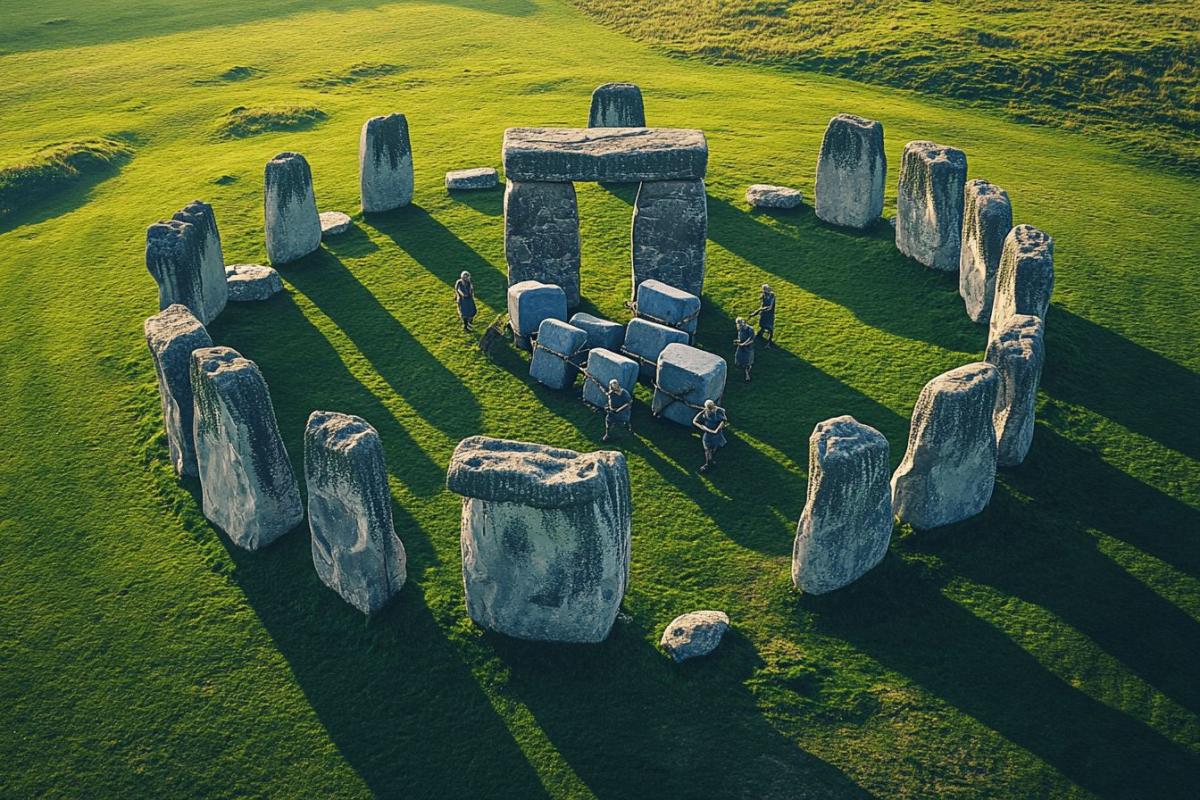
Recent archaeological investigations have fundamentally challenged long-held theories about how the iconic bluestone megaliths reached Stonehenge from Wales. Scientists at Aberystwyth University have published groundbreaking research that definitively proves human transportation rather than glacial movement brought these massive stones across 140 miles of British countryside over 5,000 years ago.
Scientific evidence debunks glacial transport theory
The comprehensive study, published in the Journal for Archaeological Research, examined crucial physical evidence that completely undermines the glacial hypothesis. Researchers focused their analysis on the Newall boulder, a significant artifact excavated in 1924 and currently housed in Salisbury Museum’s collection. This particular specimen served as a critical test case for understanding the transportation methods used by Neolithic peoples.
Advanced analytical techniques including X-ray examination, geochemical analysis, microscopic investigation, and detailed surface textural studies revealed compelling evidence. The research team discovered that the boulder shows no characteristics consistent with glacial transport and modification. Previous theories suggested that ice movement had reduced the boulder’s size and heavily altered its shape during the long journey from Wales to Wiltshire.
However, the scientific evidence tells a different story. The boulder’s current form and surface features can be explained through natural weathering processes rather than glacial action. Most significantly, the research identified the boulder as a fragmented monolith from Stonehenge itself, likely representing the buried remnant of Stone 32d, which was originally transported from Craig Rhos-y-Felin by ancient peoples.
Absence of glacial erratics supports human transport
The study’s most compelling argument against glacial transport lies in the complete absence of expected geological evidence across the Welsh landscape. If massive ice sheets had indeed carried bluestones from the Preseli Hills to Salisbury Plain, researchers would expect to find scattered erratics of similar stone types throughout the intervening territories.
The distinctive spotted dolerite that comprises 66% of Stonehenge’s bluestone monoliths presents particularly strong evidence. This unique rock type, representing 30 of approximately 45 bluestone monuments, should appear as glacial deposits across west and south Wales if ice transport had occurred. Yet despite extensive geological surveys, no spotted dolerite erratics exist beyond the vicinity of Narberth.
| Evidence Type | Glacial Theory Prediction | Actual Findings |
|---|---|---|
| Spotted Dolerite Distribution | Scattered erratics across Wales | None found east of Narberth |
| Boulder Surface Features | Heavy glacial modification | Natural weathering patterns |
| Ice Sheet Extent | Reaching Salisbury Plain | No evidence of southward extension |
| Stone Quarrying Sites | Natural glacial plucking | Evidence of Neolithic extraction |
Archaeological evidence from Preseli Hills quarry sites
The research team identified substantial archaeological evidence supporting deliberate human extraction at two key locations in the Preseli Hills. Both Craig Rhos-y-Felin and Carn Goedog show clear signs of Neolithic stone quarrying activities, contradicting theories that natural glacial processes removed the bluestones from their source locations.
These quarry sites reveal sophisticated extraction techniques employed by ancient peoples approximately 5,000 years ago. The evidence suggests that Neolithic communities deliberately selected and removed specific stone types from these locations, transporting them across considerable distances to construct one of Britain’s most enigmatic monuments.
The abundance of spotted dolerite at Stonehenge, combined with its complete absence as glacial erratics in expected locations, provides irrefutable evidence of human agency. The research definitively states that no ice extended as far south as Salisbury Plain during the relevant geological period, making glacial transport physically impossible.
Implications for understanding Neolithic engineering capabilities
This revolutionary research fundamentally transforms our understanding of Neolithic technological achievements and social organization. The confirmed human transport of massive stone blocks across 140 miles of challenging terrain demonstrates remarkable engineering capabilities and coordinated community effort among ancient British populations.
The logistics involved in moving these enormous stones would have required:
- Sophisticated planning and route selection across varied topography
- Advanced transportation technologies including rollers, sledges, and possibly waterway navigation
- Coordinated labor forces involving multiple communities
- Sustained commitment over extended time periods
- Deep cultural significance motivating such extraordinary efforts
The research published by Aberystwyth University experts represents a definitive shift in archaeological understanding. By eliminating the glacial transport hypothesis, scientists have restored proper recognition to the remarkable achievements of Neolithic peoples who created one of the world’s most enduring monuments.
This groundbreaking study reinforces Stonehenge’s status as an extraordinary testament to ancient human ingenuity, determination, and sophisticated engineering capabilities that enabled the construction of this iconic megalithic structure using stones deliberately selected and transported from distant Welsh quarries over five millennia ago.


